As regenerative agriculture gains cultural and economic value, major brands are moving quickly to adopt the language. This is not a sign of alignment. It is a sign of risk. When a term becomes valuable, the dominant system absorbs it, redefines it, and uses it to reinforce its own logic.
This is the pattern that hollowed out “organic,” “natural,” “sustainable,” and “local.”
There is no reason to believe “regenerative” will be treated differently.
The incentives of global brands are clear:
- protect market share
- satisfy ESG requirements
- reduce climate‑risk exposure
- maintain margins
- meet consumer demand for authenticity
- avoid structural change
None of these incentives aligns with the ecological, social, or cultural requirements of regeneration.
This blog explains why major brands can’t deliver regeneration without changing their business models. And they have no intention of doing so.
Keypoints
- The dominant food system always absorbs and dilutes valuable ecological terms
- Industrial structures are fundamentally incompatible with regenerative systems
- Brands will adopt regenerative language without changing their business models
- Global supply chains break the relationships regeneration requires
- Business models will remain extractive until the system forces change
Organic: The First Movement Brands Learned to Hollow Out
Before “regenerative” was a term, organic was the movement that tried to protect soil, farmers, and communities from industrial agriculture. It began as a philosophy: soil as a living system, farms as ecological communities, and food as a relationship between people and place.
But once organic gained cultural and economic value, the dominant system moved quickly to absorb it. They saw an opportunity for revenue and rebranded. Brands even changed some practices; no synthetic pesticides, no GMOs, no synthetic fertilizers. This is all good, but the underlying industrial structure remained intact.
- monocropping continued
- tillage continued
- long-distance shipping continued
- centralized processing continued
- global procurement continued
So, today we have organic and industrial organic. That’s comparing the farmer at the farmers market with Earthbound Farms. The table below is indicative of the differences
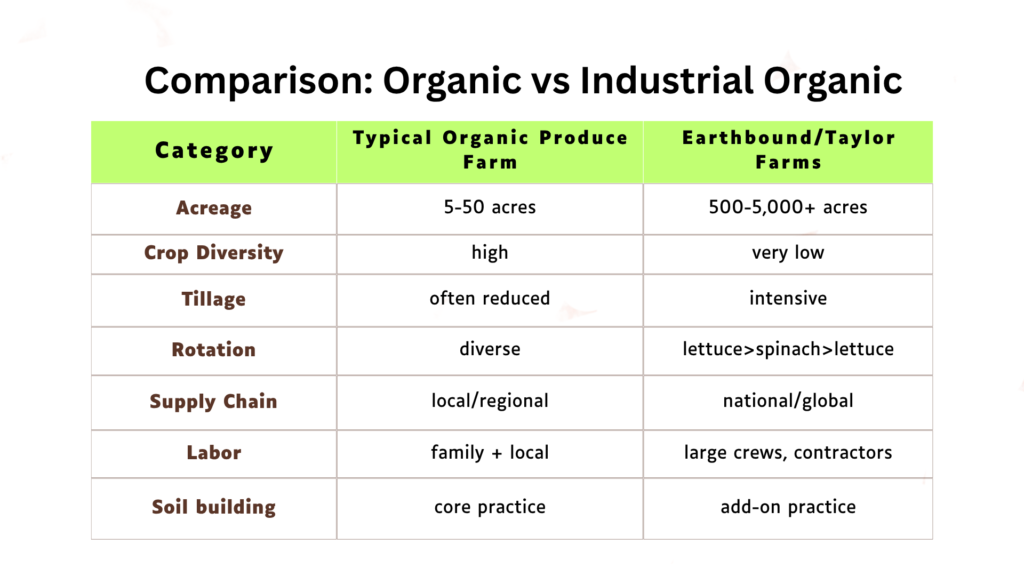
Earthbound and Taylor Grower are used here as an example. Although the differences are radical between “organic” and “industrial organic” produce, consumers don’t see that and associate any organic with:
- healthier food
- better farming
- climate solutions
- authenticity
- trust
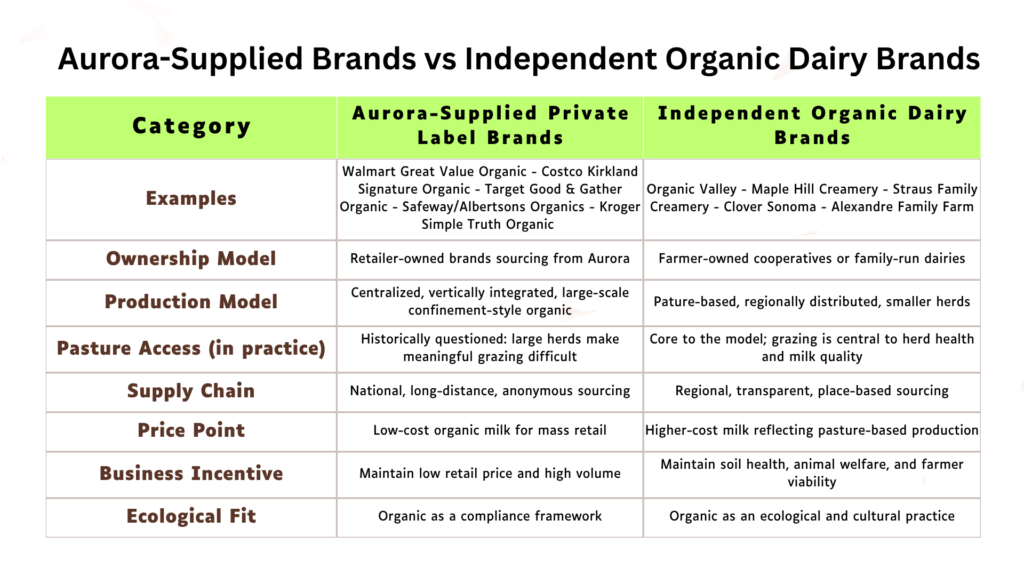
The co-option of organic doesn’t stop with fruit and vegetables. One of the biggest dairies in the United States is Certified Organic, the Aurora Dairy. You may never have heard of it, but you may be buying their milk under one of their many labels.
Their business model is CAFO (confined animal feeding operation), although they say they raise their 22,500 head of milking herd on pasture. From their website, they make the following promises:
“Our organic promise to you:
Cows never given antibiotics, synthetic growth hormones or other prohibited substances
At least 30% of cow feed is from organic pasture during the grazing season
Pasture not treated with synthetic pesticides, herbicides or fertilizers; produced without GMOs
Milk processed in certified-organic milk plants”
When these statements are fact-checked, they are correct. These are also the bare minimum required by the CCOF (California Certified Organic Farmers), one of the most influential organic certifiers in the US. And a certifier that also has a strong lobbying arm.
Aurora is available under many store brands as this table shows. If you buy any of these brands you’re supporting Aurora Dairy.
Organic Crops are All Grown in Soil, Right?
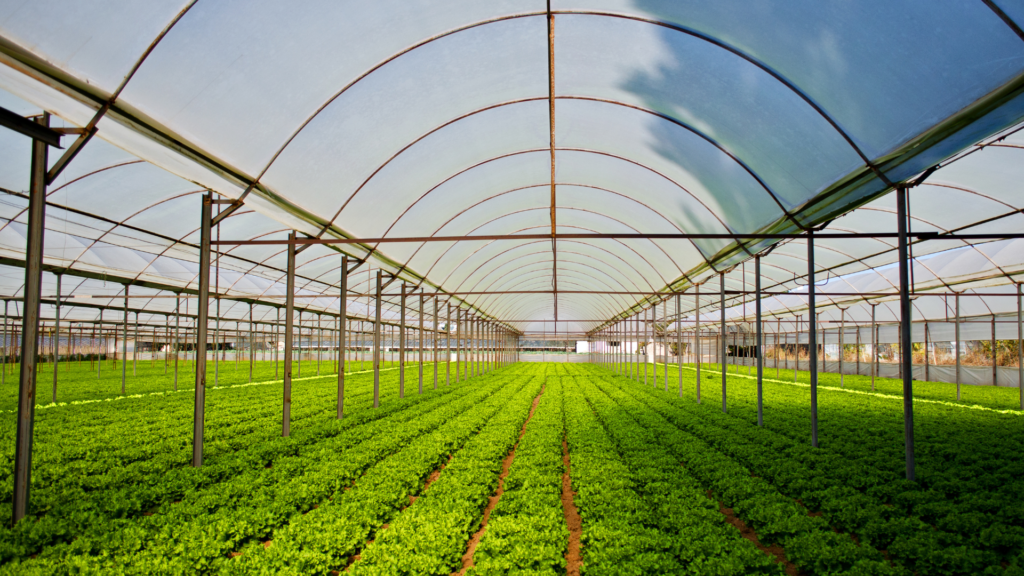
Soil is really important for organic production, right? Not so fast. Beginning in 2010, certifiers started approving hydroponic organic. No soil needed. But because synthetic salts used in conventional hydroponics aren’t allowed in organic, there is a workaround.
Hydroponic organic operations use soluble organic fertilizers, such as:
- fish hydrolysate
- soy hydrolysate
- molasses-based nutrient solutions
- seaweed extracts
- soluble humates
- amino acid–based nitrogen sources
These are all fine soil amendments and do add nutrients to the plant hydroponic growing medium. But that misses the point.
These are allowed because they come from “natural” sources. But they are still fed directly to the plant, bypassing soil biology entirely. Some hydroponic organic operations add Bacillus species and mycorrhizal fungi. This is an attempt to mimic soil biology, but it’s nowhere near the complexity of relationships in a soil ecosystem.
This is the key contradiction:
Organic rules were written for soil systems, but hydroponics uses inputs designed to replace soil.
In case you’re scratching your head in wonderment about “hydroponic organic,” the National Organic Standards Board (NOSB) has repeatedly voted against hydroponics. But they’ve been overridden by the USDA, industry pressure, and certifier incentives. The USDA issued this statement in 2019:
“The USDA National Organic Program allows certification of hydroponic, aquaponic, and container-based systems.”
It didn’t matter what the NOSB thought. The money won. And that is how industrial-scale organic has entered and dominated the market. They grow at a scale that has no regard for the relationships they are breaking.
Industrial-scale producers entered the market with:
- monocropped organic vegetables
- confinement organic dairies
- hydroponic “organic” with no soil at all
- global supply chains shipping “organic” thousands of miles
- certification loopholes that allowed industrial practices under an ecological label
The USDA’s National Organic Program is a compliance framework, not an ecological one.
Certification shifted from protecting soil to verifying paperwork. Large-scale operations shaped the standards to fit their needs, not the movement’s values. The OTA (Organic Trade Association) employs 4 full-time lobbyists in Washington DC. The OTA doesn’t represent farmers or ranchers; it represents the entire organic food supply chain. In other words, it lobbies to retain global supply chains for its members.
Who are the “members” of the OTA? Large organic brands like Earthbound Farms ( a subsidiary of Taylor Farms), Driscoll’s Berries, General Mills, organic certifiers, organic processors and distributors, and anyone who has a financial stake in the health of the global organic supply chain. Oh, and some organic farmers who are also ecological.
The centralization of power in Industrial Organic has had an outcome that was predictable.
- organic became a market category, not a worldview
- soil health became optional
- monocropping and tillage continued
- global supply chains stayed intact
- small ecological farms were pushed to the margins
Organic wasn’t defeated. Large growers and livestock producers redefined it. They adopted organic certification while maintaining monoculture production, long-distance shipping, and industrial-scale operations. They meet the letter of the organic rules but not the spirit of soil-based, diversified organic farming.
It was redefined.
And this is the warning for regeneration:
Once a term becomes valuable, the dominant system absorbs it, dilutes it, and uses it to reinforce its own logic.
Organic was first.
Regenerative is next in line — unless the movement protects it.

You Can't Globalize a Relationship
Regeneration has become the new kid on the block with a great story and high market value. Brands are already reaching for it. The language is compelling to consumers. It talks of healing, reciprocity, and caring for the land. It’s language that sells to Gen Zs who don’t want chemicals on their plates. It sells to moms who want clean food for their children.
But those companies don’t want the system that underlies regeneration. They aren’t interested in maintaining the integrity of the delicate web, spun by casting one silk thread at a time to build up relationships.
Regenerative practice depends on local nutrient cycles, regional supply chains, community governance, ecological complexity, and long-term relationships. Global brands depend on the opposite: uniformity, predictability, scale, centralized procurement, and quarterly returns. These two logics do not meet in the middle.
The story of regeneration can travel through a global supply chain; the regenerative web of relationships can’t.
Brands want access to the regenerative story because it sells. But they do not want the decentralized system that supports it. That system is incompatible with global logistics and centralized control.
Regeneration requires:
- local nutrient cycles
- regional supply chains
- community governance
- long‑term relationships
- ecological complexity
Global brands require:
- uniformity
- predictability
- scale
- centralized procurement
- quarterly returns

These requirements cannot be reconciled. But many global brands are making the attempt. And that is a major concern. If they are able to convince consumers that all regenerative is created equal, there will be no real regenerative producers. They will go the way of small organic producers, niche at best. Abandoned the farm at worst because they couldn’t make it pay.
Regenerative farmers and ranchers have to make a living. They are also tied to place and understand the value of the relationships between all the anchors of regeneration. The system, as it is, doesn’t have a place for a rancher who transitions to regenerative grazing to improve the soil, food, producer, and eater relationships. But with the magic of the internet and telling the story of the farm, the strands of the web can be extended. And without breaking.
The intent is not about growth at all costs; it’s about trying to scale trust and communicate the value of regenerative living. Those online sales protect place. They extend the trust, transparency, and story of their land to people who choose to buy from them.
They work within the constraints of local nutrient cycles, regional identity, and care for the ecosystem. And often that passion is communicated far beyond their immediate vicinity in the attempt at economic survival. The message of place and relationship is heard by a customer who then looks around and sees their own place in a new light.
There is evidence that story-driven place-based producers actually shift consumer behavior. CSA membership consistently increases members’ awareness of local agriculture. Members report feeling more connected to where their food comes from, with an increased awareness of local farms.
Direct relationships with farmers and ranchers change purchasing behaviors. D2C farm customers report shifting additional food purchases to local sources.
D2C meat producers begin the relationship awareness of consumers, and of those people who bought regenerative meat D2C, many look for local regenerative or grass-fed producers.
The ability to see the relationships may be fuzzy at first, but it grows stronger over time. Unless brands co-opt the language and the imagery.
Brands Will Adopt the Regenerative Ag Language Without Changing the Structure
As consumers become more attentive to place, practice, and relationship, the value of regenerative language rises; and that’s exactly the moment brands begin to adopt the words without adopting the work. The story becomes a marketing asset long before the system becomes a business commitment. And when language is lifted out of the relationships that gave it meaning, something subtle but measurable happens: consumer trust begins to erode.
People can feel the gap between the story they’re being sold and the system that would be required to make it true. This is the pattern we’ve seen with “natural,” then “organic,” then “sustainable,” and now “regenerative.” The moment a label gains value, industry learns how to use it without changing structure. People who have been an integral anchor of the regenerative system are the first to notice the mismatch.
The industrial system has a consistent strategy for absorbing disruptive ideas:
- Adopt the vocabulary
- Redefine it to fit existing operations
- Market it aggressively
- Use scale to dominate the narrative
- Push out smaller, more authentic actors
This is not speculation. It is the documented trajectory of every major food‑system label over the last 40 years.
“Organic” was diluted through certification loopholes and industrial monocultures.
“Natural” became meaningless through marketing.
“Sustainable” became a corporate PR term.
”Local” was stretched to include anything within a multistate region.
“Regenerative” is next in line.

Regeneration Ends Where Global Supply Chains Begin
Regeneration requires short nutrient cycles and local accountability. Global supply chains break both.
A brand sourcing “regenerative” ingredients from thousands of miles away is not supporting regeneration. It is exporting nutrients, erasing context, and reinforcing the same extractive logistics that degraded soil in the first place.
If a company claims to support regeneration while maintaining:
- centralized processing
- long‑distance hauling
- global procurement
- anonymous supply chains
…then the claim is structurally false. Regeneration doesn’t happen at the global scale; it happens at the watershed and regional level. It can’t be shipped across the globe.
Regenerative snack bars are a good example of this tension. They are tasty, and we all like them. But even if there are only 3 ingredients (and there are almost always more), a snack bar with oats, cacao, and coconut sugar has sourcing from 3 continents. Those ingredients travel thousands of miles, leaving behind nutrients, carbon, and community value that true regeneration depends on. The brand gets the story, the landscape loses the cycles and the web of place-based relationships.
Does this mean if we live in the Northern Hemisphere, we’re doomed to never taste chocolate again? No. But it does mean we know the story of the chocolate, know the landscape it comes from, and we honor that relationship to place.
As a child growing up in rural Michigan, my parents took this quite literally. We almost never had citrus or chocolate. We had plenty of fruit pies, from apples and peaches. Lots of strawberry shortcakes, too. Of course, not all ingredients were locally sourced. But “exotic” fruits and vegetables were rare treats. And we treated them as such. I think that’s the piece we miss when we assume anything and everything is available all the time.
We have lost the knowledge of seasons and the taste of a food that is picked perfectly ripe. Regenerative living brings that back with the knowledge of the placeness of being.
And this is exactly where the trouble begins. The moment regeneration becomes something consumers can feel, brands rush to turn that feeling into a set of practices and metrics they can scale, measure, and market.
Brands Will Reduce Regeneration to Practices and Metrics
There’s nothing wrong with being systematic. With being organized. But when it comes with the loss of reciprocity, it is no longer serving the web of relations. And it’s a subtle shift that many won’t even notice. That’s what big brands are counting on. We won’t see the change because the message still speaks to our inner sense of belonging and caring.
To fit regeneration into their systems, brands will simplify it into:
- a checklist of practices
- a carbon score
- a certification
- a marketing claim
This reduction is inevitable because global systems require standardization. They can’t handle the ecological and cultural complexity that regeneration demands. But they can handle the language.
Once regeneration becomes a checklist, it becomes easy to manipulate:
- adopt the easiest practices
- ignore the hardest ones
- optimize for carbon credits
- outsource verification
- maintain business as usual
- use the language of reciprocity without the obligation
This is compliance, not regeneration. But will anyone notice?
Brands Will Use Scale to Dominate the Narrative
Small regenerative brands will notice. They’ll notice customers drifting away toward cheaper, more convenient versions of the story they’ve come to be a part of. Awareness doesn’t eliminate influence.
When a global brand adopts regenerative language, it can outcompete the very people doing the work. Not because it’s more trustworthy, but because it has greater reach. It can say its message in more places and more often; it just has more resources.
This isn’t a failure of consumers or of regenerative producers. It’s simply what happens when the question stops being “who’s doing the best work” to “who’s telling the most compelling version of the story.” We are often like little kids. Almost all of us have a person we listen to, consider what they say, and feel they have given us solid advice. We also have another person (usually a spouse or parent) who can say the same thing, and we don’t pay attention. It’s all in the telling of the story.
And once the power of the story becomes clear, the next move is predictable: the brands with the biggest megaphones step in and begin defining what that story means for everyone else.
As major brands adopt the term “regenerative,” they will take control over the public definition. Their version will be:
- simplified
- scalable
- certification‑friendly
- carbon‑focused
- supply‑chain compatible
This version will overshadow community‑rooted, place‑based regeneration because it will have more marketing dollars behind it. The language will be very much the same. General Mills is adept at painting the picture of regenerative agriculture across many brands.
The result is predictable:
- consumers will assume “regenerative” means something it doesn’t
- authentic regenerative producers will be marginalized
- the movement will lose coherence
- the term will lose meaning
This is not a hypothetical risk. It is the default outcome unless regenerative living defines its boundaries clearly.
Business models remain extractive until the system removes extraction as the profitable choice
Regeneration requires:
- decentralization
- regional supply chains
- slower logistics
- higher labor investment
- long‑term thinking
- community governance
Global brands require the opposite. They cannot adopt regenerative living without abandoning the economic logic that makes them profitable.
They will not do this voluntarily.
They will only do it if the market, policy, or culture forces them to.
Right now, none of those forces is strong enough.
The Movement Must Define Regeneration Before Brands Do
If the movement does not define regeneration, brands will define it for their own convenience. They will choose definitions that:
- preserve global supply chains
- minimize operational change
- maximize marketing value
- reduce complexity
- avoid accountability
To prevent this, regeneration must be defined in terms that cannot be co‑opted:
- place
- reciprocity
- community
- circularity
- accountability
- local nutrient cycles
- regional economies
These are incompatible with global corporate structures. The whole point of this is to point out that incompatibility. Numerous regenerative industry players still do not see this as a major issue. Many are trying to fit Regenerative into the Global Supply Chain.
Anonymity of the global supply chain breaks regenerative; reciprocity of local supply chains fuels it. It makes a difference when an eater knows their supplier and the supplier knows the eater.
The Stakes Are Structural, Not Semantic
This is not a debate about terminology. It is a conflict between two systems:
System A: Globalized, extractive, centralized, efficiency‑driven
vs.
System B: Local, reciprocal, community‑rooted, ecologically literate
Only one of these systems can support regeneration and survive into the next century. Brands will try to merge the two. They cannot be merged.
Now that we’ve established the antagonist – System A, how do we go about regenerating System B? We’ve had it before; it’s not new. We’ve just forgotten it. Many farmers and ranchers are already using System B.
In my next blog, I’ll go into what food chain structures are actually working at regenerating soil, communities, and people’s health. The structures that allow a producer to make a living while stewarding the land.